Virtual Clinical Simulation Training

Welcome to Inspirational by Design®
Who We Are
We are a Virtual Simulation Training Service in the field of Healthcare.
What is Virtual Clinical Simulation Training?
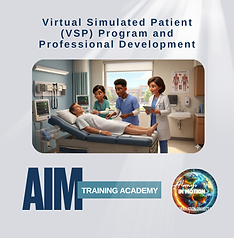
Virtual clinical simulation training is an interactive, online learning experience that lets students and professionals practice real-world healthcare skills—anytime, anywhere—without needing a physical simulation lab. Instead of mannequins or in-person standardized patients, our programs use live simulated patients (SPs) and Virtual AI Patients, AI-enhanced scenarios, video game simulators, escape-room-style challenges, interprofessional teamwork, and AIM communication frameworks like FAST and REAL to build competence, confidence, and clinical judgment.
What We Do
-
Professional development and online training: Workshops, courses, and learning experiences designed to build practical skills and support continuing education.
-
Virtual interprofessional education: Engaging IPE courses and events that bring disciplines together for collaborative learning.
-
Customized simulation and live events: Tailored simulation experiences, interactive sessions, and live programs aligned with audience needs.
-
Webinars, conferences, and moderated virtual events: End-to-end support for Zoom events, webinars, conferences, and facilitated online sessions.
-
Consulting services: Guidance in instructional design, content creation, educational technology, course development, workshops, speaking engagements, and interactive lectures.
We proudly offer the AIM Simulation Project© Curriculum for Virtual Services.
Who We Serve
-
Healthcare Learners
-
Healthcare Faculty and Professionals
-
Clinical Simulation Professionals
-
Simulated Patients (SP)
-
Non-Healthcare Professionals
-
Universities, Colleges, Programs, Associations
-
Healthcare Systems
PROFESSIONAL DEVELOPMENT PROGRAMS
Click on your role below to learn more.

Healthcare Students

Healthcare Faculty & Simulation Educators
Simulated Patients (SP)

Land & Indigenous Peoples Acknowledgment*
Colorado Springs, Colorado | Healthcare Education & Simulation We gather today on land that was never surrendered. The City of Colorado Springs stands on the homeland and unceded historic territory of many Indigenous Nations, and the very founding and development of this city was in direct violation of the Fort Laramie Treaty of 1851. The Nuuchiu (pronounced New-chew, meaning "the People"), known colonially as the Ute, are the longest continuous Indigenous inhabitants of what is now Colorado. According to Nuuchiu oral history, they have no migration story. Their people have been here since time immemorial. According to the oral history of the Kapuuta and Mouache, two of the twelve historic bands within the Nuuchiu Nation, Pikes Peak is one of the places where the Creator placed their Ancestors. While Colorado Springs lies within Ute ancestral homelands, the city only comprises a small portion of Ute territory that once covered over 200,000 square miles. A minimum of 48 federally recognized Sovereign Nations, including the Kiowa, Jicarilla Apache, Comanche, Tsistsistas (Cheyenne), and Hinóno'éí (Arapaho) also have historic ties to this place and continue to foster their relationships with this land. We name what happened here. The Fort Laramie Treaty of 1851 guaranteed ownership of the area north of the Arkansas River to the Nebraska border to the Tsistsistas and Hinóno'éí. Waves of Euro-American miners then flooded across the region in search of gold in Colorado's Rocky Mountains, placing extreme pressure on the resources of the plains. The 1851 Fort Laramie Treaty that originally defined Plains tribes' territory was broken, and a new Fort Wise Treaty of 1861 required the Tsistsistas and Hinóno'éí to cede all previously agreed territory except for a small reservation. In return for wanting peace and trying to comply with government directives, on November 29, 1864, approximately 750 tribe members, mostly women, children, and the elderly, were attacked and approximately 230 killed by the Colorado Cavalry at Sand Creek, ordered by Colorado's Governor John Evans, whose name still sits on a mountain in this state. Many of those soldiers were from the 3rd Colorado Cavalry. Before departing, the troops burned the village and mutilated the dead, carrying off body parts as trophies. The Tsistsistas and Hinóno'éí were then confined to reservations in what is now Oklahoma. Arapaho tribal headquarters, shared with the Southern Cheyenne Tribe, is primarily located in the communities of Concho and El Reno, Oklahoma because they were forced out of this land. On the reservations, Nations faced poverty and disease, as well as targeted efforts to erase their culture. The U.S. government imposed assimilation policies, attempting to erase Indigenous cultural practices through boarding schools and the prohibition of traditional religious ceremonies and languages. We are a healthcare education organization. That context is not incidental to this acknowledgment. In the 1840s, James Marion Sims, a white doctor in Montgomery, Alabama, performed painful experiments without anesthesia on Lucy, an enslaved Black woman, while other doctors observed. Physicians during and after enslavement often denied Black people basic dignity and personhood through mistreatment that reflected the prevailing and dehumanizing myth that Black people were less sensitive to pain than white people. Anarcha, Lucy, and Betsey were enslaved women from Alabama who changed the history of gynecology. Dr. J. Marion Sims developed medical tools and surgical techniques related to women's reproductive health with neither consent nor anesthesia, and later became credited as the "father of modern gynecology," while Anarcha, Lucy, and Betsey were left out of the history books. That erasure is not history. It is the architecture of the medical system we are training people to work inside of. We name it because naming it is the beginning of the only kind of healing that is real. The Southern Ute Indian Tribe and Ute Mountain Ute Tribe are federally recognized Nations with their current headquarters in Ignacio, Colorado and Towaoc, Colorado, respectively. They are here. They are governing. Their sovereignty is active their treaty rights are ongoing, and the United States continues to violate both. We acknowledge that reality with specificity, not sentiment. This acknowledgment is a commitment, not a ceremony. We commit to actively incorporating Indigenous knowledge systems and medical sovereignty into this curriculum, to supporting the political and legal sovereignty of the Nations whose land we occupy, and to submitting this statement to Nuuchiu, Tsistsistas, and Hinóno'éí representatives for review, accountability, and correction. We do not speak for them. We speak to our own responsibility.

Reparative Justice Commitment *
Colorado Springs, Colorado | Healthcare Education & Simulation The United States built its medical establishment on the bodies of Black people without their consent. That is not metaphor. It is the structural foundation of the profession we are gathered to teach. On a slave farm in Alabama in 1844, James Marion Sims founded a small hospital where experimental procedures and established his legacy as the "Father of Gynecology." The history at issue was the torture and experimentation on enslaved Black women, including Anarcha, Betsey, and Lucy, whose forced contributions to the fields of obstetrics and gynecology were discarded and erased while Sims's contributions were glorified. J. Marion Sims operated on enslaved women with neither their consent nor anesthesia, despite giving anesthesia to white women after having perfected this procedure. During and after enslavement, physicians often denied Black people basic dignity and personhood through mistreatment that reflected the prevailing and dehumanizing myth that Black people were less sensitive to pain than white people. That myth is not dead. It is active in emergency rooms, labor and delivery wards, and simulation labs right now. Every person in this room who works in healthcare is inheriting that legacy, and we are accountable to it. We acknowledge the organized, state-sanctioned architecture of racial harm that has shaped Black life in America: chattel slavery, medical experimentation without consent, the convict leasing system as re-enslaved labor, the GI Bill structured to exclude Black veterans, the federal policy of redlining that locked Black families out of intergenerational wealth. Redlining has had a lasting impact on Colorado Springs neighborhoods and on the wealth of Black families. Today, historically redlined neighborhoods in this city continue to do worse economically and are currently more at risk for housing instability and homelessness than predominantly white neighborhoods that were rated "better" in the 1930s. We name the specific history of this city. Black residents of Colorado Springs have always lived with subservient laws, rules, and attitudes, discrimination, and institutionalized racism. Throughout this city's history, this has resulted in segregation, lynching, redlining, the robbing of pensions, inheritances, and property, health disparities, police violence, and mass incarceration. On August 3, 2019, De'Von Bailey, a 19-year-old Black young man, was shot to death by Colorado Springs Police officers as he ran away. Bailey's death sparked an outcry in this city that gained national attention. These racist structures continue to contribute to disproportionate outcomes for Black residents of Colorado Springs. Racism is not a thing of the past. We acknowledge that healthcare education is not neutral ground. The simulation technologies, curricula, and clinical standards we teach carry the embedded assumptions of a system built by and for white bodies, white pain thresholds, and white patients as the default human. That is not an abstraction. It is a bias currently operating inside every training scenario that does not name it. Reparative justice, as named by scholars and organizers within Black communities, demands truth, structural accountability, and material repair. It is not a feeling. It is a framework for action. Therefore, as an organization, we make the following material commitments. We commit to auditing every simulation scenario and curriculum in active use for anti-Black medical bias, including pain assessment tools, default patient presentations, and clinical language that encodes racial hierarchy. We commit to recruiting Black faculty at full pay equity with their white peers, with no discount applied to what the market has historically offered Black professionals, because that market rate is the harm. We commit to partnering with Black-led community health organizations in Colorado Springs with funded, sustained relationships, not advisory optics. We commit to incorporating the named histories of Anarcha, Betsey, and Lucy into our foundational training, so that every student who moves through this program knows whose bodies built the tools they are learning to use. We commit to transparently reporting our progress on these commitments annually, to the communities most harmed, not to ourselves. Recognition is not repair. This statement is the beginning of what repair requires, not the end of it.
*Our statements have not yet been reviewed or approved by representatives of the Southern Ute Indian Tribe and Ute Mountain Ute Tribe, or the NAACP. You can read our personal statement and commitment at the links shown above.
STAY CONNECTED!

Interprofessional Collective Meeting: Expanding Simulation Beyond Healthcare.
FREE to the Public!
An open, commitment-free space where leaders and educators from diverse fields come together to learn, connect, and collaborate.
Date: Third Friday of the Month
Time: 12:00 - 1:00 PM (EST)
Register at the link below and add to your calendar!
Interprofessional Collective Resource Website

Upcoming Events

Designing a Virtual Escape Room Course
Self-Guided:
Starting 11/2/26
Workshop:
Cohort Starting 11/17/26
Self-Guided Course: Design an immersive virtual escape room on your schedule. This flexible five-week online course guides you through AI tools, game-based learning, storytelling, instructional design, and interactive technology as you build a complete educational experience ready to use in your own setting. Hybrid Course: Bring your educational escape room to life with expert guidance and peer collaboration. Over five weeks, live Zoom workshops and flexible online modules help you confidently design, build, and facilitate an engaging virtual learning experience using AI, simulation, and interactive technology.

2nd Annual Moulage Showcase
Show will air on October 31st.
Get ready for the 2nd Annual Moulage Showcase, featured on Inspirational by Design®’s Inspiration and Innovation Hour animated web series! Bring your imagination!
Check Out Our Latest Videos!

I&IH Animated Web Series & Podcast
Episode 9: AI Solutions for Educators with special guest Dr. Liz Robison.

IPE Collective Meeting: Expanding Simulation Beyond Healthcare
October Webinar: "Mass Casualty Incident (MCI) Training through Simulation." Presented by Dr. Lisa Steele.

EdTech DIY Workshop
We explore Educational Technology, create an AI generated video, build a chatbot, and discover a virtual escape room course.
EdTech DIY Website
Click on the link below to access workshop materials.
Guest Appearances

33 Conversations Podcast with Michael Abney
Episode: The Missing Training in Healthcare

AI in Education presents Custom Bots/GPTs with Casandra Silva Sibilin
Episode: EdTech DIY Demo
INTERACTIVE EXPERIENCE

ASSOCIATION MEMBER: